Share of voice in AI answers measures how often answers in a defined prompt set mention your brand. Calculate it by dividing answers naming you by all answers collected. A mention alone says nothing about recommendation position, so separate branded prompts from buying questions before using the result to guide changes.
How share of voice in AI answers is calculated
A tracker starts with a list of prompts, often a few dozen to a few hundred, written to cover a category (“best protein powder for women”, “quietest air purifier for a bedroom”). It sends each prompt to each engine it covers, such as ChatGPT, Gemini, Perplexity or Google AI Overviews, and parses the answers for brand names, so the work is mechanical and cheap to repeat. Your share of voice is the number of answers that name you divided by the number of answers collected. Some tools also report share against named competitors, so you see your slice of all brand mentions in the set.
The method is simple and repeatable, which is its strength: run the same prompts every day, keep the engine and search mode fixed, and you get a trend line showing whether your presence in that particular prompt set is rising or falling. For a brand reporting to leadership, that line answers a fair question. For a store trying to sell a specific product, it leaves out most of what decides whether a shopper buys.
A mention leaves out position
A mention is a binary event in a presence-based calculation: the brand either appears somewhere in the answer or is absent. Binary counting flattens four different outcomes into one count: a first-place recommendation, a fifth-place listing, a mention with a warning (“some users report sizing issues”), or a mention that appears only because the prompt asked about you by name.
Position is an omission worth checking because an answer can name your product while recommending another product ahead of it. In Metrisque’s stored runs, one store we will not name passed Brand Recall, so it would collect mentions on branded prompts, yet in 11 saved Question Finder reads on memory and web search it got no first-place recommendation for its category’s buying questions. A share chart that includes branded prompts would show that store as visible every day.
| What share of voice counts | What it leaves out |
|---|---|
| Whether the brand name appears in an answer | Where in the answer it appears, first or fifth |
| Mentions over every prompt in the set | Whether the prompt named the brand itself |
| Mentions per engine | Whether memory and web search agree |
| Share against named competitors | Why the model prefers a competitor |
| A daily or weekly trend | Which product page, category filing or source caused a change |
Table 1. Mention counts leave questions about position, prompt intent and sources unanswered; reviewing those details helps identify what to investigate next.
The same question gives different shares
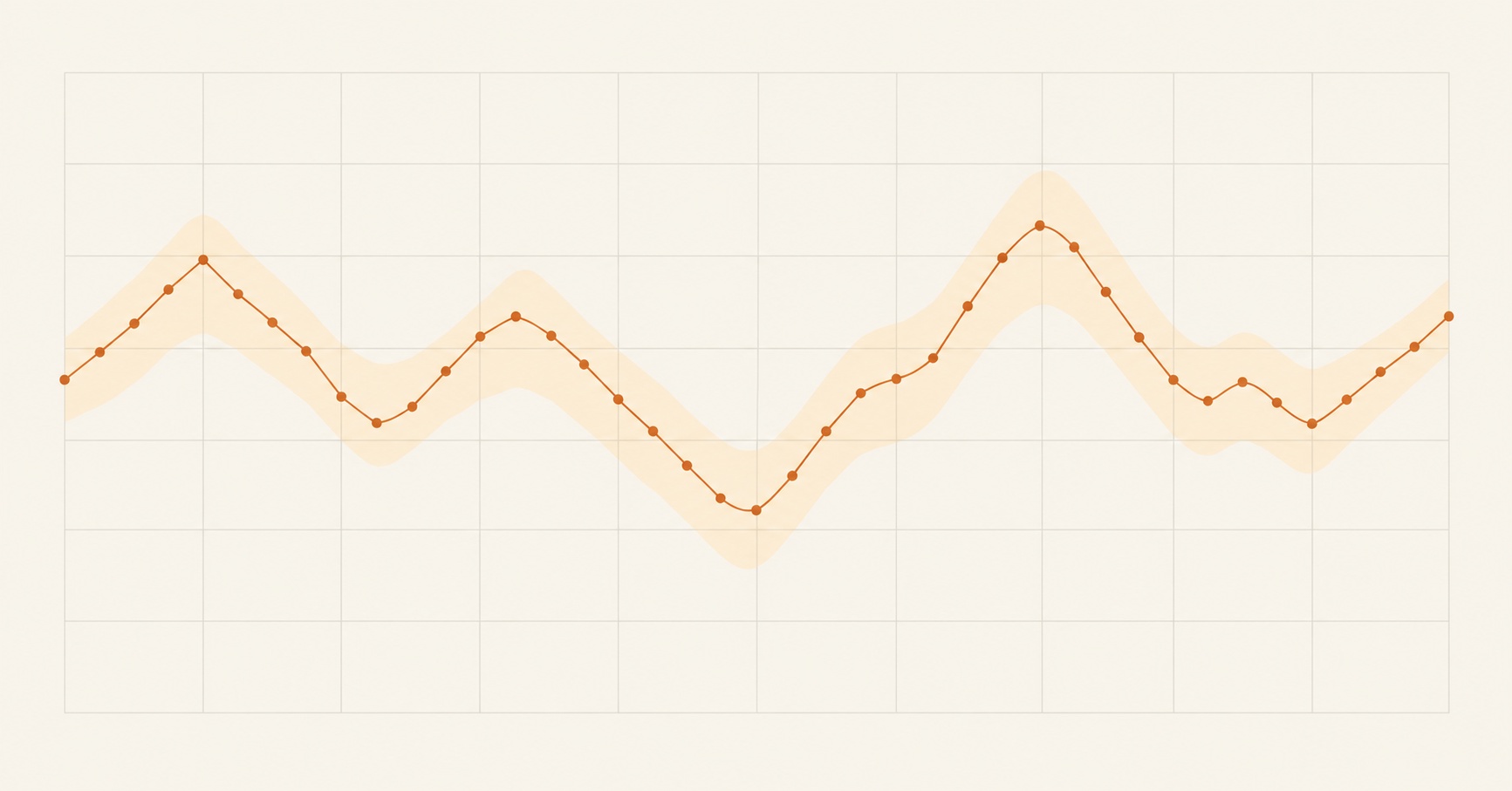
Share moves between runs even when nothing about your store has changed. Models generate answers by sampling, so the same prompt can return a different list or a different order on a second try. Answers with web search turned on also depend on which pages the search returns at that moment, and those results shift as sites publish and rank. Model updates can change a whole category’s answers overnight.
Prompt wording adds another source of movement. “Best sauna for a small apartment” and “compact home sauna recommendations” are close in meaning, yet they can return different brands, because the words themselves change which products look relevant to the model. If a tracker’s prompt set changes, or if the tool writes fresh prompts each run, share can swing on wording alone. Our post on why AI answers change between runs covers how to control for each of these when you measure.
Read share as a range because a single day’s number is only one sample of the answers your setup can produce. A week of runs, or three to five repeats of each prompt on the same day, gives you a spread, which helps you judge whether an apparent change deserves investigation.
Branded prompts inflate the number
Prompt sets often mix two kinds of question. Unbranded prompts name a need (“best magnesium supplement for sleep”) and test whether the model reaches for you unprompted. Branded prompts name you (“is Brand X magnesium any good?”) and test recall, because the model will almost always mention a brand the user typed a moment earlier. When both kinds sit in one share figure, recall props up the number and hides weakness on the questions that bring new customers.
The fix is to report the two separately. Unbranded share shows how often the model chooses you when a shopper has not decided yet. Branded share shows whether the model describes you accurately once a shopper has heard of you, which is closer to what Metrisque’s Brand Recall measure checks, with its verdict scoped to the exact name asked. A store with high branded share and low unbranded share should investigate recommendation coverage, including category filing, page content and third-party sources.
A second distortion comes from the competitor list. Share against competitors only covers the rivals you told the tool to look for. If the model recommends a marketplace listing, a store brand or a newcomer you have not listed, your share against “competitors” can rise while your real share of the answer falls. Reading the full answers for a sample of prompts each month, instead of only the parsed counts, catches rivals the setup missed.
Share against position
The more useful view crosses share with position. We call the rate at which a brand is the first product recommended for a buying question its first-place share. It is a stricter count than share of voice, because it ignores branded prompts and lower list positions, and it distinguishes leading recommendations from appearances further down a list.
Crossing the two gives four situations. High share with first-place recommendations means you are winning and should watch for drift. Low share with first-place recommendations means you win the questions you appear in and should widen coverage. Low share without first place means presence is the gap. High share without first place is the trap, because the share line looks healthy while shoppers hear a rival named first.
A low share needs a diagnosis
A low share number shows limited presence within the measured prompt set, without establishing the cause or a wider market result. The cause could sit at any of four levels: the model does not know your name, it files your product in another category, your pages do not answer the buyer’s question, or the sources it trusts name rivals. Each needs a different fix, and the share number cannot separate them.
Metrisque’s measures map to those levels. Brand Recall checks the name. Category Fit checks filing, and in the latest read for 53 stores it marked 13 of 923 products Outside their expected category, while Buyer Match checks whether pages answer buyer questions and Competitors and Citations shows which sources the models lean on. Running these on the products behind a low share line turns a single falling number into a short list of edits.
Once the edits are live, run the same buying questions again and compare them with a stored baseline. Metrisque’s Action Plan works this way, with a re-measure after each fix. Share of voice is a reasonable number to watch afterwards, as a broad check that nothing has slipped by engine.
Share of voice suits brand reporting
Share of voice earns its place in some jobs. An agency reporting on dozens of brands needs a comparable number for every client, a brand selling through retailers controls few pages and mainly needs to watch the trend, and a marketing lead presenting to a board needs a line that moves in a direction the board can follow.
For those uses, share works best with three guards: a fixed prompt set, branded prompts reported separately from unbranded ones, and repeated runs so the spread is visible. Add first-place share beside it and the report starts to show what shoppers hear. Our guide to measuring AI search visibility sets out the full set of measures and how they relate.
How do I measure share of voice in AI answers?
Measure share of voice by dividing answers that mention your brand by all answers collected for the same prompt set. Record the assistant, search mode and prompt wording alongside each answer so that later comparisons use the same setup and denominator.
How do I track brand mentions in AI? Send a fixed set of buying questions to each assistant, record which brands appear and in what position, and repeat the runs. Keep branded and unbranded prompts separate so recall does not inflate your count.
Why does my AI share of voice change every day? Models sample their answers, web search results shift, and model updates change category answers. Read share as a range over repeated runs and act only on changes outside that range.
Is share of voice a good LLM visibility metric? It is a fair trend measure for brand reporting when the measurement setup stays consistent. For a store, pair it with first-place share and a diagnosis of causes, because share does not show position or the reason for a low number.
Sources
- Metrisque stored runs: Question Finder case (one unnamed store, 11 reads, memory and web search). Category Fit latest read (13 of 923 Outside, 53 stores). Read on 16 November 2026.
Start with a free Metrisque check to see what to investigate beyond your share of voice in AI answers.